Winter Haven Comfort Retreat
Rebuilding a Florida vacation rental's page-builder website into twenty-three hand-built pages that Google can actually read — and aiming them at the bookings the big travel platforms are structurally bad at winning.
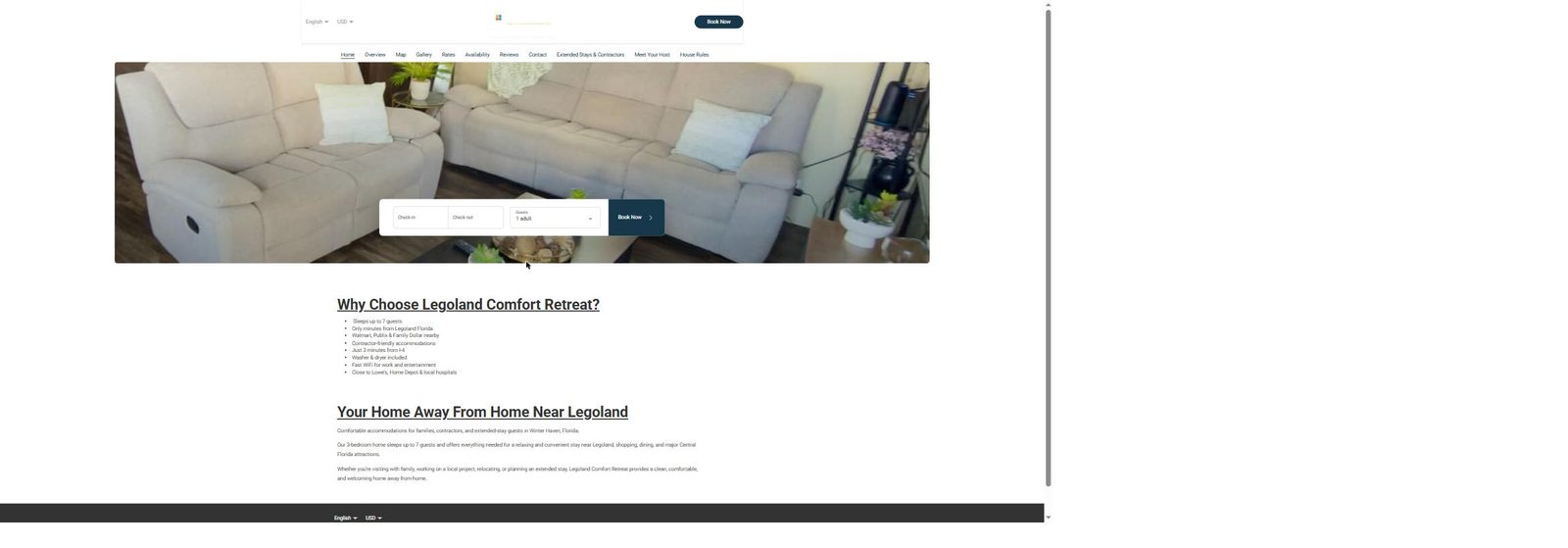
A ten-page site whose title tag said “Home.”
The house was already earning five-star stays. The website was a rental-platform page-builder template, and it shipped placeholder metadata to every guest and every crawler that ever visited.
- The title tag was literally “Home”So was the meta description. So were the og:title and og:description. Every Google result and every shared link led with the word “Home” instead of the name of the business.
- Google's Rich Results Test: “No items detected”No structured data of any kind. Nothing told Google this was a lodging business, what it cost, where it was, or that it held a five-star rating.
- Content injected by JavaScriptThe builder rendered as a client-side app — the least reliable way to be read by a search crawler, and the least useful thing to hand an AI answer engine.
- Distance claims that didn't survive checking“Only minutes from Legoland Florida” and “Just 3 minutes from I-4.” Measured properly, those are 20 minutes and 13 minutes. Guests find out the moment they get in the car.
- Ten thin pages, none built to rankNo page had the depth to compete for anything, and every service and audience was crammed into the same handful of URLs.
- One thin page for long stays, and nothing built to be foundThere was an “Extended Stays & Contractors” page, and the homepage did say “contractor-friendly.” But it was a single unoptimised page with no title, description or schema of its own — nothing search could rank — and nothing at all for travelling nurses or monthly renters.
You cannot out-rank Booking.com. So don't try.
The obvious search is “vacation rental near Legoland.” Look at who owns that result page: Airbnb, Vrbo, Booking.com, Tripadvisor, HomeToGo. A single-property site on a new domain does not beat those, and pretending otherwise is how small businesses spend a year losing slowly.
- The maths on that fight is badThe aggregators hold domain authority a one-house site cannot approach. Worse, the competing rentals that do rank locally sit around 1.7 miles from the park, several with pools. This property is a 20-minute drive away. That is a fight lost on the merits before SEO even enters into it.
- But the platforms are weak where the stays are longSomeone searching “travel nurse housing near Winter Haven Hospital” or “monthly rental Polk County” is badly served by an interface built around weekend date-pickers. Across this market there was almost no purpose-written content aimed at them at all.
- And long stays are simply better businessA thirteen-week contract is one changeover instead of thirteen — less cleaning, less turnover risk, and revenue you can forecast. The guest who books for a season is worth more than the guest who books for a Saturday.
- So the site was pointed there insteadThree landing pages built for contractors and crews, travelling nurses and clinicians, and monthly renters — written the way those guests actually search: commute time to the hospital, parking for work trucks, in-home laundry, Wi-Fi good enough for charting, and rates quoted by the week.
- Then the same pages in Spanish, because nobody else hadThree Spanish landing pages with reciprocal hreflang, aimed at a large local working population that the entire local market was ignoring.
The proximity content stayed, and so did the trip-planning blog posts — they still bring families in at the top of the funnel and still convert the ones who find the site. What changed is that the whole business stopped betting on a search it was never going to win, and started competing where it holds a real, defensible advantage.
That is the difference between doing SEO and doing positioning. Ranking is downstream of picking a fight you can actually win.
Ten pages became twenty-three, each with a job.
Every page hand-built as static HTML — no page builder, no client-side rendering, nothing between the crawler and the content.
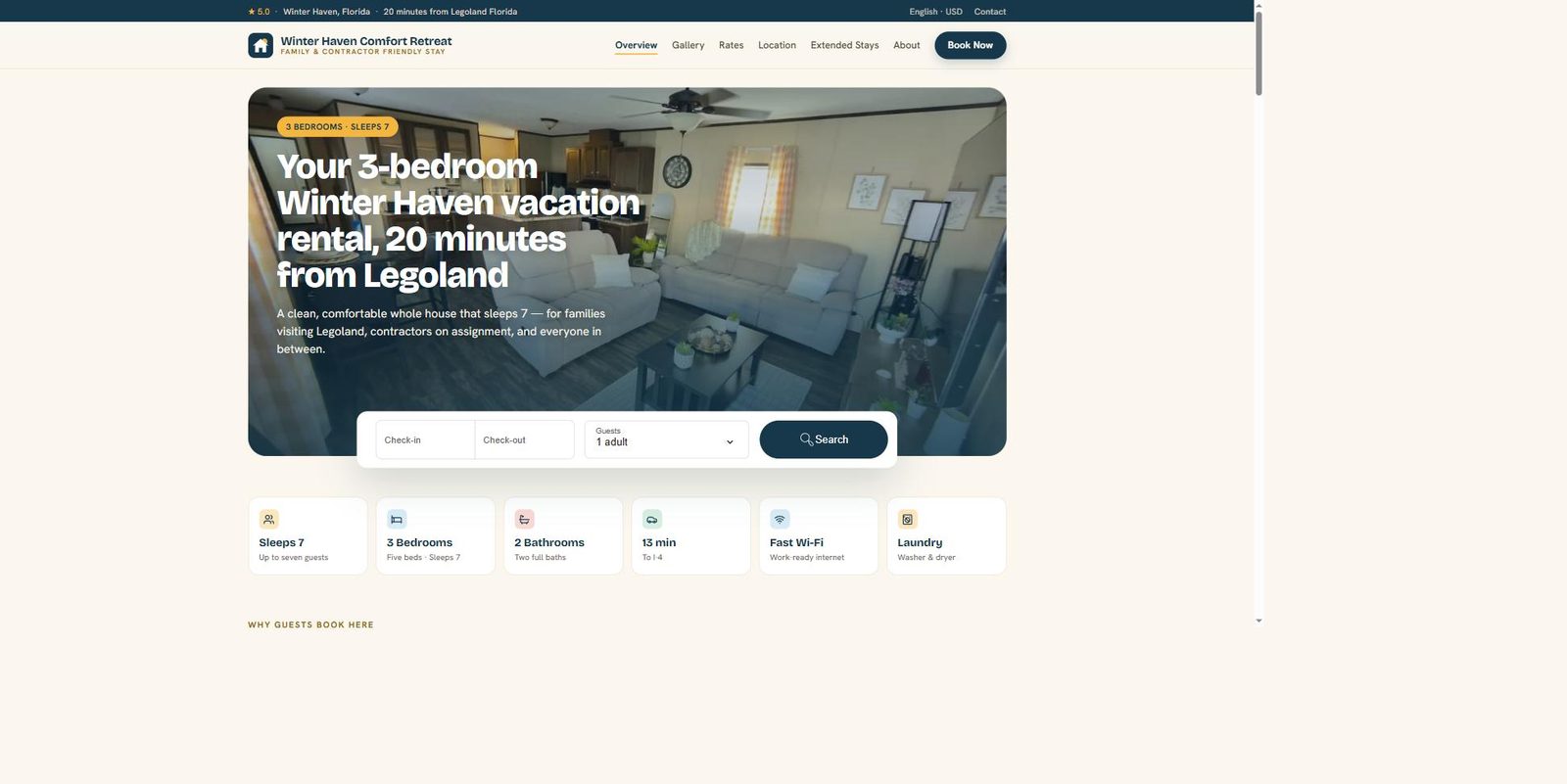
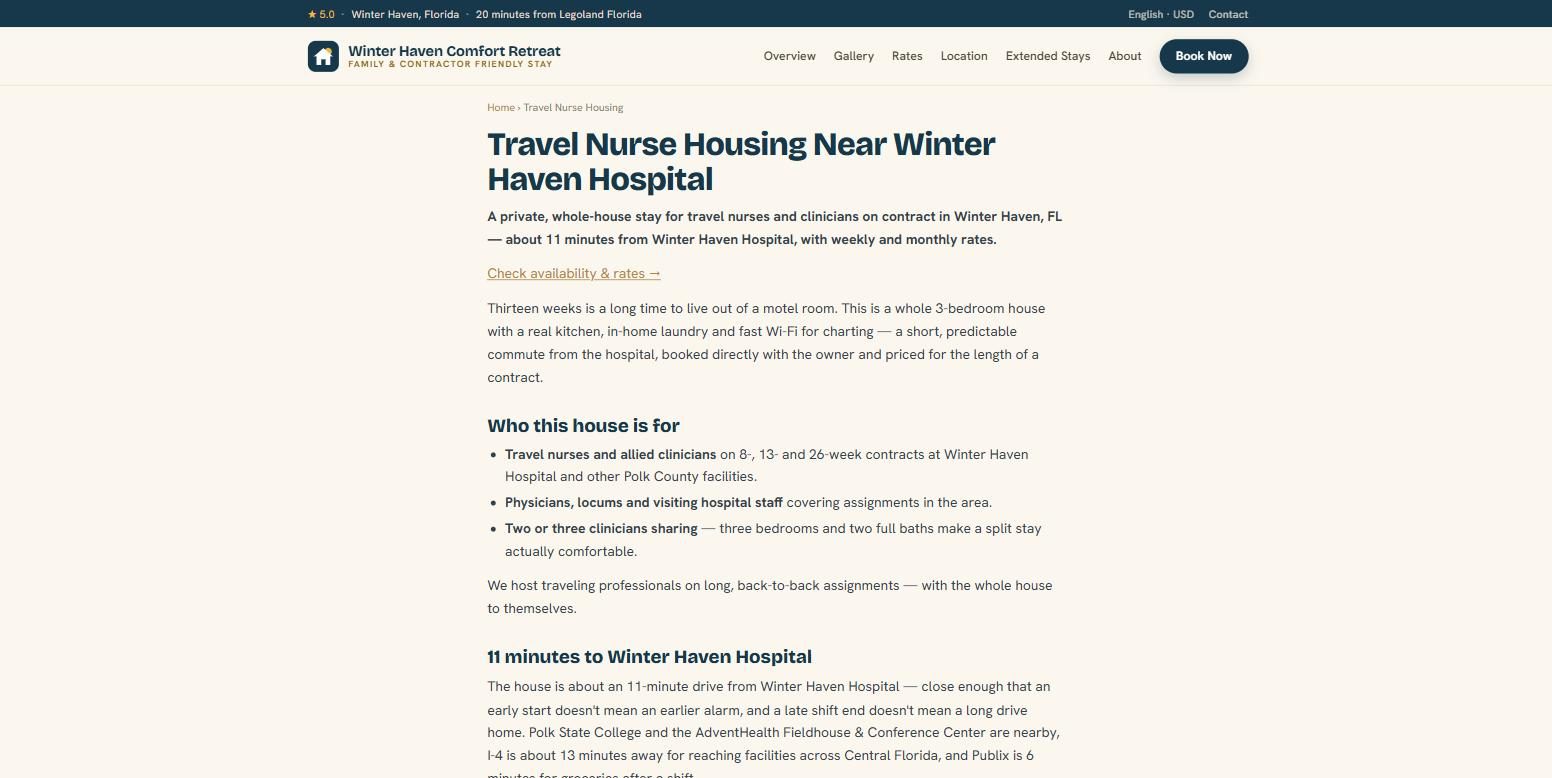
The booking engine was the one thing worth not touching.
The old platform was genuinely bad at being a website. It was perfectly good at being a booking engine — live availability, payments, reservation management and the owner's existing workflow all ran through it, and had done for years.
So it stayed. The booking widget was embedded into the new site and themed to match, rather than replaced with something homemade that would have to be trusted with real money on day one. The rebuild replaced the ten pages that were losing guests and left the one system successfully taking their bookings completely alone.
Knowing which half of a bad setup is actually working is most of the job.
Before → after, line by line.
The familiar pages are all still there — Gallery, Rates, Location, Extended Stays, Host, Contact — but every one was rebuilt, and a great deal was added.
- Target search
- Fighting the platforms→where they're weak
Off the head-on “vacation rental near Legoland” fight against Airbnb and Booking.com, and onto long-stay searches with real intent and almost no competition.
- Audience
- One page for contractors→6 targeted pages
The contractor angle existed but was never built to rank. Now it has its own page, plus travelling nurses and monthly renters, in English and Spanish.
- Platform
- Page builder→hand-built + Netlify
Off a rented template and onto a fast, version-controlled static site that can change hosts in an afternoon.
- Pages
- 10→23
Six landing pages across two languages, a blog, policies — each with unique metadata.
- Title tag
- “Home”→written per page
Every page now has its own title, meta description and self-referencing canonical.
- Structured data
- None→full schema layer
LodgingBusiness, Organization, WebPage, FAQPage, BreadcrumbList and Review — so search and answer engines can read the property as an entity rather than an unlabelled page.
- Rendering
- JavaScript SPA→static HTML
Content in the source, where every crawler and every AI assistant can reach it without executing anything.
- Language
- English→English + Spanish
Three Spanish landing pages with reciprocal hreflang, for a local workforce nobody else was writing for.
- Distance claims
- Unverified→measured
Every proximity figure re-measured and corrected. Guests learn the truth in the car anyway — better they read it on the site first.
- Brand
- Named for a landmark→a name they own
The business had been trading on a domain built around a trademark it didn't control. Renaming to Winter Haven Comfort Retreat removed that exposure while it was still cheap — the descriptive “near Legoland Florida” copy guests search for stayed exactly where it was.
- Booking engine
- Deliberately unchanged
Embedded and re-themed rather than rebuilt. The part that worked was left working.
- Measurement
- None→GA4 sitewide
Analytics in the owner's own account, on every page.
- Old URLs
- Would 404→301 redirects
Every path the old platform published is mapped to its replacement, so bookmarks and search history follow the business across.
A business that finally owns its own front door.
The site is new — days old on its domain at the time of writing. What follows is what has actually been measured, and what is honestly still ahead.
- Found under its own name within daysIndexed and ranking for the business name almost immediately after the new domain went live — the fastest available confirmation that the migration was executed cleanly.
- Machine-readable for the first timeSix schema types replacing nothing at all, on static HTML rather than JavaScript. The property can now be read, quoted and attributed by Google and by whatever people are asking next year.
- Six routes to revenue nobody else in the market builtThree long-stay landing pages in English, three in Spanish, aimed at bookings that run for weeks rather than nights.
- Honest about what a new domain can't have yetThird-party auditing puts on-page at 75% and technical at 80%, while off-page sits at zero — because a domain this new has no backlinks and no social footprint. That isn't a defect in the build; it's the one thing only time and outreach supply.
- A sequenced road ahead, not a vague suggestionGoogle Business Profile, Search Console verification, retiring the old domain properly, and local link building — handed over in priority order.
- No lock-in anywhereSite in version control, domain in the owner's name, analytics in the owner's account, and the booking engine untouched and still theirs.