Monty's Concrete LLC
Taking a 20-year Rochester concrete contractor off an all-in-one platform that owned her website, her leads and her customer list — and rebuilding it as a hand-built site with a real CRM and analytics she owns, one that produced twenty-eight estimate requests and $101,110 in quoted work in its first month, plus a second market in Florida.
Twenty years of work, behind a template nobody finished.
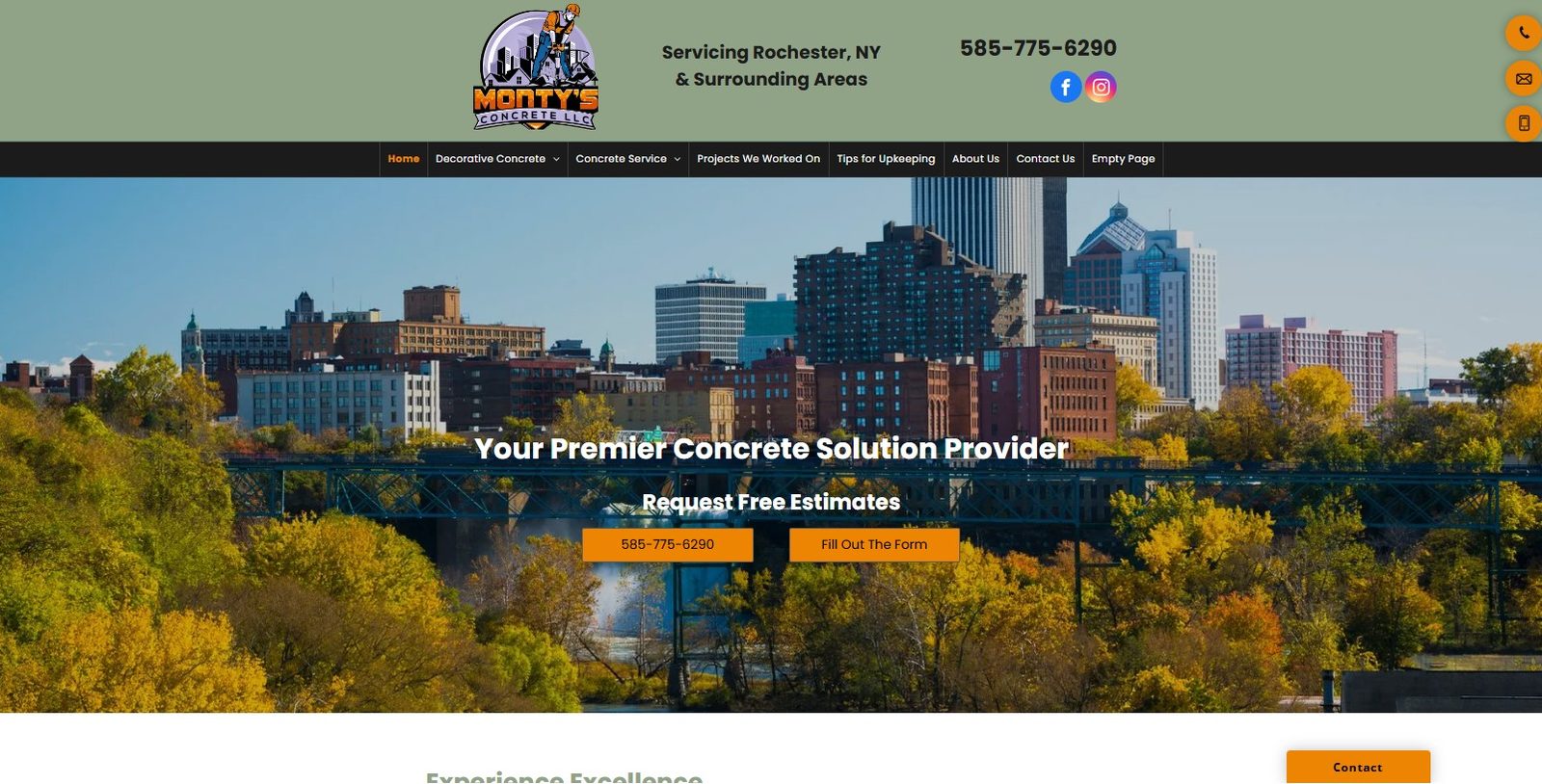
Monty's has poured concrete across Monroe County for two decades. The website didn't say that. It was an entry-level DIY builder site — billed at $360 a month, and still left unfinished.
- A page in the navigation literally called “Empty Page”Shipped to every visitor, on every page of the site.
- The About page said “Coming Soon”The one page where a 20-year track record should live was a headline and nothing else.
- Unedited template copy still on the Tips page“List Item 3 — Write a description for this list item…” was live on the public site.
- The Instagram icon went nowhereIt pointed at Instagram's logged-out homepage rather than the business profile.
- Every service crammed onto one pageDriveways, garage floors, patios and sealing all lived on a single Concrete Service URL — so none of them could rank for their own search.
- No structured data for Google to readNothing describing who she is, what she does, or the towns she works in.
- A published postal address for a service-area businessThe footer listed a city-and-ZIP address, which conflicts with how a crew that travels to jobs should appear in local results.
- The platform owned everythingWebsite, lead inbox, customer list and the domain registration all sat inside one vendor — billed monthly, with the data hard to get out.


Thirty-five pages, each one earning its own search.
One page trying to rank for everything ranks for nothing. The rebuild split the work into pages that match how people actually search — by service, and by town.


The website was the easy half.
The old platform wasn't just hosting — it was the CRM, the lead inbox and the customer database. Replacing the site meant replacing all of it without dropping a lead.
- 1,522 customer records exported and rebuiltEvery contact reformatted to the new CRM's import spec and segmented — active customers separated from cold leads — so the list arrived clean instead of as one undifferentiated dump.
- Lead routing rewired end to endEstimate requests now land directly in the CRM as a job request, where they can be scheduled and quoted, instead of sitting in a platform inbox she was renting.
- Seven old URLs mapped to 301 redirectsEvery page the old site had ranked for now points at its replacement, so two decades of search history follows the business across.
- Analytics she ownsGA4 on all 35 pages, with estimate submissions tracked as lead events — so for the first time there's a real answer to “where do the calls come from?”
- Domain ownership untangledThe registration sat with the old vendor. Getting it released was its own piece of work, and the thing most migrations discover far too late.
All-in-one platforms make leaving expensive on purpose. The site, the leads, the customer list and the domain are bundled, so switching any one of them means untangling all four. Most small businesses stay put for exactly that reason.
She was paying $360 every month for that bundle — for a site with “Empty Page” in the navigation. The replacement CRM costs $360 for the year, and the site itself is free to host. Same money, twelve times the period, and the work is finished.
Monty's now runs on pieces she owns independently: the site is in version control and can move hosts in an afternoon, the customer data lives in a CRM built for contractors, and the analytics belong to her Google account. Nothing here is a hostage.
Before → after, line by line.
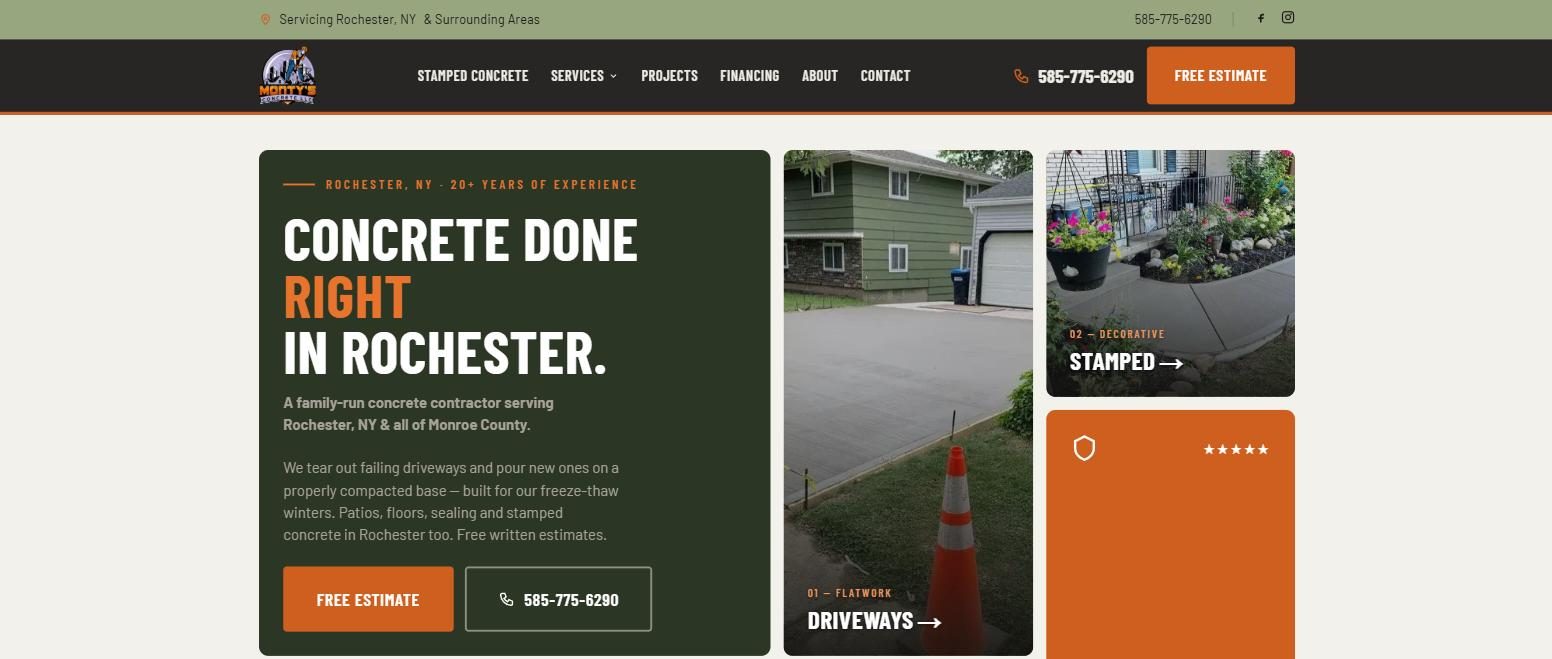
The familiar pages are still there — Services, Projects, Tips, About, Contact — but every one was rebuilt, and a great deal was added.
- Platform
- All-in-one builder→hand-built + Netlify
Off a rented page builder and onto a fast, version-controlled site she owns outright.
- Pages
- 7→35
Service pages, 14 town pages, project case studies, a blog — each with unique metadata.
- Placeholders
- “Empty Page,” “Coming Soon”→real content
Every template leftover removed and replaced with copy about the actual business.
- Structured data
- None→full schema layer
GeneralContractor, Service, FAQPage and BreadcrumbList — so Google can read the business.
- Local footing
- One city mention→14 town pages
Written individually, not spun from a template, and correctly canonicalised to themselves.
- Social proof
- Generic claims→real Google reviews
Named customer reviews and genuine before/after photography from her own jobs.
- Lead capture
- Platform inbox→CRM job request
Requests arrive where the work is scheduled and quoted, not in a rented inbox.
- Measurement
- None→GA4 + lead events
Every page tracked, every estimate request recorded as a conversion.
- Financing
- Not mentioned→surfaced sitewide
Consumer financing presented on 20 pages, where it can affect the decision.
- Old URLs
- Would 404→7 × 301
Ranking equity and old bookmarks carried forward instead of dropped.
The old site gave machines nothing to read.
People don't only type into Google anymore. They ask ChatGPT, Gemini, Perplexity and Google's AI overviews “who does stamped concrete near Rochester?” — and those systems answer from sites they can actually parse. The old site was unreadable to every one of them.
- Search engines — nothing to indexThe title tag was just the business name. No meta descriptions, no canonicals, and every service sharing one URL, so no page could rank for the search that mattered to it.
- Answer engines — nothing to quoteAEO is about being the source an assistant pulls its answer from. That needs real questions answered in plain language, marked up so a machine knows they're questions. The old site had none.
- Generative engines — nothing to identifyGEO is about a model being able to say with confidence what this business is, what it does and where it works. With no structured data, Monty's was an unlabelled page rather than a known entity.
A full schema layer so the business is machine-legible: GeneralContractor and Service markup describing exactly what she does, FAQPage across eight pages answering thirty-one real customer questions, and BreadcrumbList sitewide so the structure is unambiguous.
Then the facts an answer engine needs to be confident: twenty-nine towns declared in areaServed, fourteen town pages written individually rather than spun, and a unique title, description and canonical on all thirty-five pages.
The result is a site that can be read, quoted and attributed — by Google, and by whatever people are asking next year.
And it worked: ChatGPT, Gemini and DuckDuckGo all now show up as real referral sources in her analytics.
A business that owns its own front door.
- Twenty-eight estimate requests in the first monthArriving daily by the end of it — often two a day — from eleven different towns across the service area.
- $101,110 quoted, $17,750 already approvedNineteen written quotes came out of those requests inside the first month. The rest are live in her pipeline.
- Leads from eleven towns, not just RochesterRochester, Victor, Penfield, Spencerport, West Henrietta, Fairport, Pittsford, Henrietta, Scottsville, Farmington and Avon — each one a page built to be found on its own terms.
- Found for a thousand different searchesThe site appeared in Google roughly ten thousand times in its first month, across a thousand distinct searches. The old site surfaced for a handful.
- Nine in ten visitors were strangersAlmost everyone clicking through searched for a service, not the business name — new customers, not people who already knew her.
- First page for the work that mattersTop two for concrete resurfacing and overlays in Rochester; top ten for stamped concrete, decorative concrete and concrete contractors.
- Reviews grew on their own — 16 to 25, still 4.8★A better site and more visibility brought more customers, and more customers left more reviews.
- A second market opened inside the first monthMonty's expanded to Polk County, Florida — see section 08.
- Roughly $3,960 a year back in the businessThe all-in-one platform billed $360 a month for the site, the CRM and the lead inbox. The replacement CRM costs $360 for the year, and hosting is free.
- No vendor lock-inSite in version control, customers in a CRM she controls, analytics in her own account.
From a handful of searches to a thousand.
The old site surfaced in Google for a small handful of searches. One month after launch the rebuilt site was appearing roughly ten thousand times a month across a thousand distinct searches — and still climbing, not settling.
- Nine in ten clicks were non-brandAlmost everyone arriving had searched for a service — “concrete contractor near me,” “stamped concrete Rochester” — not for the business by name. Customers who didn't know Monty's existed.
- Mobile ranks roughly twice as high as desktopAverage position 12.6 on phones versus 24.1 on desktop, with nearly double the click rate. Google surfaces local results harder on mobile, and that's where a homeowner standing on a cracked driveway actually searches.
- The guides earn their own trafficTwo how-to articles written during the build — how long concrete takes to cure, and how often to seal a driveway — are now among the most-viewed pages on the site, with over a thousand appearances between them. One ranks first for its question.
The site worked, so she opened a second market.
Inside the first month, Monty's expanded to Winter Haven and Polk County, Florida — and the site expanded with it.
Rather than a second website to maintain, the Florida side was built into the same codebase: its own service pages, its own town pages, its own local phone number and its own structured data, all sharing one deployment.
- Stamped and decorative concrete, front and centerThe Florida service set leads with stamped and decorative concrete — the work Julie wants to own — poured and stamped in place, no thin cover-up overlays. It holds the top navigation slot across the menu, the mobile drawer and the footer.
- Full pages, not placeholdersEvery Florida service page is a complete, Florida-specific page — sandy-soil base prep, afternoon-storm drainage, pool salt and cooler colours underfoot — each roughly four times the depth it started at, with its own FAQ and in-market links.
- Real Florida jobs, not recycled stockAround thirty real project photos now run across the Florida section, replacing the four images it had been reusing — each auto-rotated, stripped of location metadata, and served as fast, mobile-sized WebP.
- Seven Polk County towns, written individuallyWinter Haven, Lakeland, Haines City, Davenport, Auburndale, Lake Wales and Bartow — each with real local detail, from the Chain of Lakes to the US-27 corridor.
- An honest resurfacing pitchThe resurfacing page uses genuine before-and-after pairs to make the promise plainly: repair or repour, never a cover-up overlay.
- Indexed and appearing within weeksTwo hundred and seventy-seven appearances in Google searches across ten Florida pages in the first few weeks live, with Lakeland drawing the most.
- One codebase, two marketsCross-linked, separately canonicalised, and deployed together — so a second location cost a fraction of a second website.